

📝 Description
 75
75

🥘 Ingredients
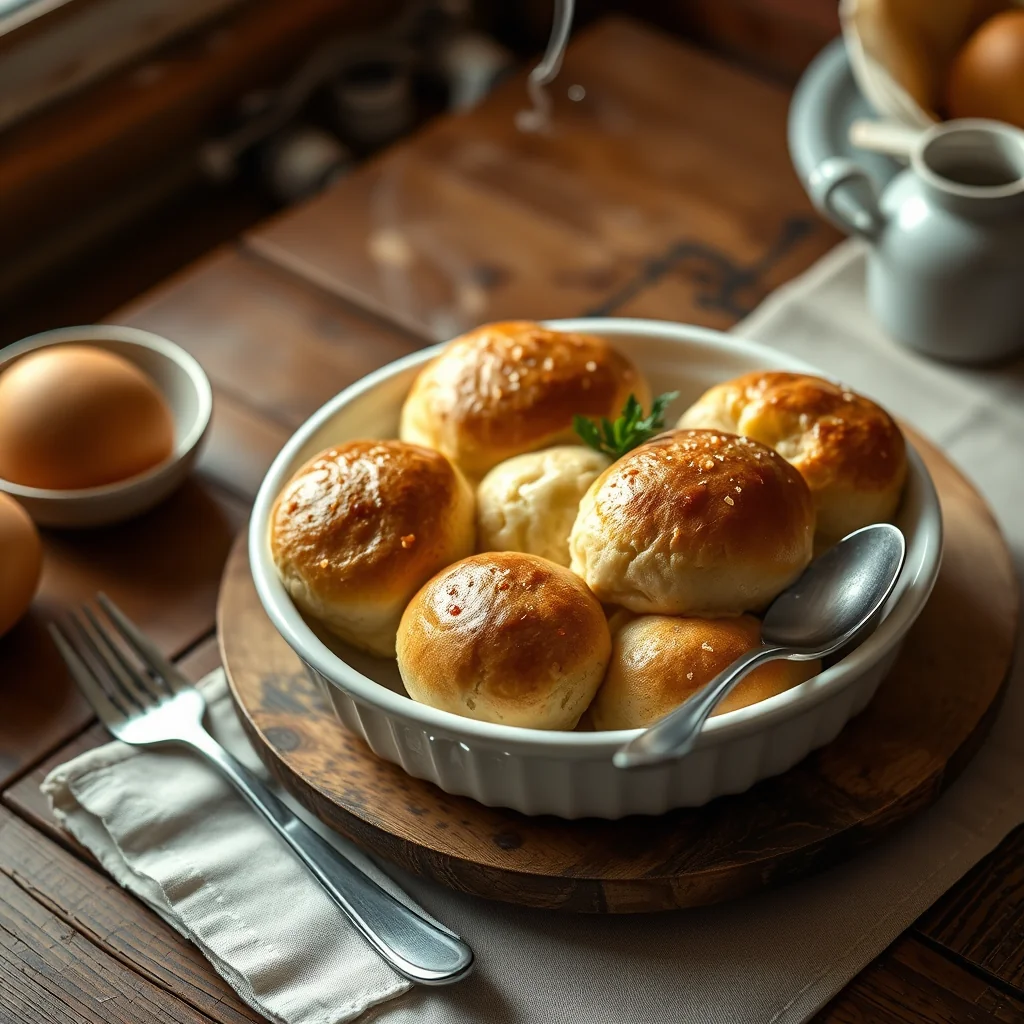
To every lb. of flour allow 1 oz. of butter, 1/4 pint of milk, 1 large teaspoonful of yeast, a little salt. [Illustration: ROLLS.]
👨🍳 Method
Warm the butter in the milk, add to it the yeast and salt, and mix these ingredients well together. Put the flour into a pan, stir in the above ingredients, and let the dough rise, covered in a warm place. Knead it well, make it into rolls, let them rise again for a few minutes, and bake in a quick oven. Richer rolls may be made by adding 1 or 2 eggs and a larger proportion of butter, and their appearance improved by brushing the tops over with yolk of egg or a little milk. _Time_--1 lb. of flour, divided into 6 rolls, from 15 to 20 minutes. HOT ROLLS. 1724. This dish, although very unwholesome and indigestible, is nevertheless a great favourite, and eaten by many persons. As soon as the rolls come from the baker's, they should be put into the oven, which, in the early part of the morning, is sure not to be very hot; and the rolls must not be buttered until wanted. When they are quite hot, divide them lengthwise into three; put some thin flakes of good butter between the slices, press the rolls together, and put them in the oven for a minute or two, but not longer, or the butter would oil; take them out of the oven, spread the butter equally over, divide the rolls in half, and put them on to a very hot clean dish, and send them instantly to table. TO MAKE DRY TOAST. 1725. To make dry toast properly, a great deal of attention is required; much more, indeed, than people generally suppose. Never use new bread for making any kind of toast, as it eats heavy, and, besides, is very extravagant. Procure a loaf of household bread about two days old; cut off as many slices as may be required, not quite 1/4 inch in thickness; trim off the crusts and ragged edges, put the bread on a toasting-fork, and hold it before a very clear fire. Move it backwards and forwards until the bread is nicely coloured; then turn it and toast the other side, and do not place it so near the fire that it blackens. Dry toast should be more gradually made than buttered toast, as its great beauty consists in its crispness, and this cannot be attained unless the process is slow and the bread is allowed gradually to colour. It should never be made long before it is wanted, as it soon becomes tough, unless placed on the fender in front of the fire. As soon as each piece is ready, it should be put into a rack, or stood upon its edges, and sent quickly to table. TO MAKE HOT BUTTERED TOAST. 1726. A loaf of household bread about two days old answers for making toast better than cottage bread, the latter not being a good shape, and too crusty for the purpose. Cut as many nice even slices as may be required, rather more than 1/4 inch in thickness, and toast them before a very bright fire, without allowing the bread to blacken, which spoils the appearance and flavour of all toast. When of a nice colour on both sides, put it on a hot plate; divide some good butter into small pieces, place them on the toast, set this before the fire, and when the butter is just beginning to melt, spread it lightly over the toast. Trim off the crust and ragged edges, divide each round into 4 pieces, and send the toast quickly to table. Some persons cut the slices of toast across from corner to corner, so making the pieces of a three-cornered shape. Soyer recommends that each slice should be cut into pieces as soon as it is buttered, and when all are ready, that they should be piled lightly on the dish they are intended to be served on. He says that by cutting through 4 or 5 slices at a time, all the butter is squeezed out of the upper ones, while the bottom one is swimming in fat liquid. It is highly essential to use good butter for making this dish. MUFFINS.
📜 From Mrs Beeton's Book of Household Management (1861). Public domain.
⭐ Reader Reviews
Honest opinions from readers who have explored this book.
I tried Mrs Beeton's Excellent Rolls this week, eager to experience a taste of Victorian comfort. I found the process surprisingly straightforward, with the yeast and butter melding beautifully with the flour to create a soft, pliable dough. The specific detail that delighted me was the second rise—those few minutes made all the difference, puffing up the rolls to a soft, cloud-like texture. This recipe is perfect for the modern comfort-seeker looking to add a touch of vintage charm to their baking repertoire. The rolls, once baked and split, are perfect for a generous helping of butter and a steaming cup of tea. The method is simple enough for a weeknight bake, and the results are sure to please. The only trick is to keep an eye on them in the oven, as they can go from golden to burnt in a flash. But with a bit of practice, you'll have a batch of Excellent Rolls that would make Mrs Beeton herself proud.