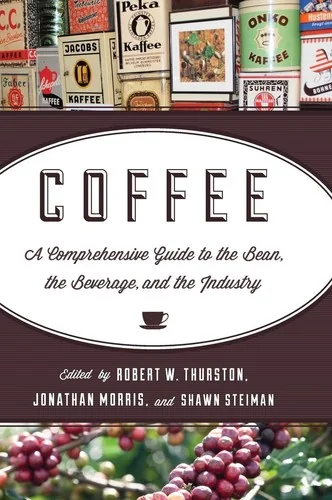
Coffee: A Comprehensive Guide to the Bean, the Beverage, and the Industry
✍️ Thurston, Robert WA multidimensional examination of coffee's global industry and cultural impact.
This collection challenges readers to look past the cup and consider the supply chain’s intricate web of politics and economics. It addresses how globalization affects local communities and why profits remain elusive for many in the production phase. The contributors provide a balanced view of the industry, highlighting the tension between consumer demand and producer welfare without offering easy solutions.
Published in 2013 by Rowman & Littlefield, this work sits at the intersection of social science and business economics. It reflects a period where global trade dynamics and environmental concerns began heavily influencing how coffee was perceived as both a commodity and a cultural staple.


📝 Description: Coffee: A Comprehensive Guide to the Bean, the Beverage, and the Industry
💎 Expert review
📖 Why choose it
Why this book is worth reading
This handbook serves professionals, students, and serious enthusiasts who seek a nuanced understanding of the forces shaping their daily beverage. Readers gain a balanced, human perspective on an often abstract industry by moving beyond simple recipes to examine the intricate web of politics, economics, and environmental impact defining the modern market. It benefits those looking to comprehend the bean's history, cultivation across Africa and Asia, and the varying definitions of certifications like organic, direct trade, and fair trade. Furthermore, it details the art and science of roasting while tracing profits through the commodity chain, illuminating the social issues, climate change challenges, and economic constraints faced by producers.
⭐ Reader reviews
Reader rating
Robert W. Thurston compiles insights from leading experts to present a rigorous, unromanticized look at the coffee trade, drawing on interviews with pickers, roasters, and shop owners. While it successfully avoids demonization or romanticization, this text will not suit casual readers seeking light coffee-making instructions, simple beverage recipes, or quick brewing tips. Instead, it demands intellectual engagement with complex economic realities, agricultural politics, and supply chain logistics. Those looking purely for a manual on latte art or home brewing techniques will find it overly dense, but dedicated enthusiasts and students of global trade will appreciate its analytical depth and grounded, multi-perspective approach.