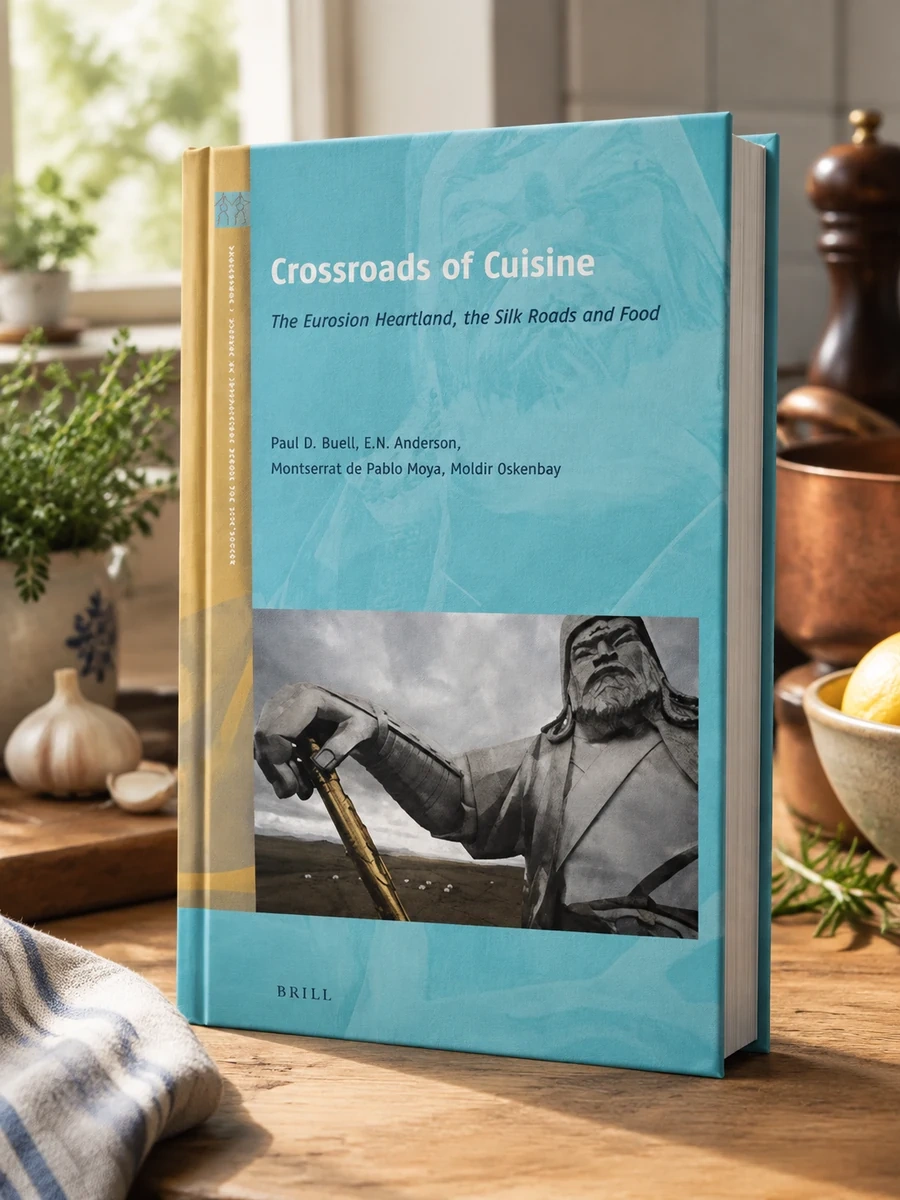
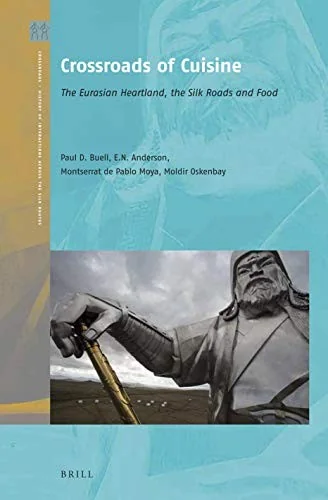
Crossroads of Cuisine: The Eurasian Heartland, the Silk Roads and Food
✍️ Buell, Paul DavidA scholarly history of food exchanges along the Silk Roads over five thousand years.
Buell argues that East and West developed in tandem through continuous culinary interaction. He moves beyond simple trade routes to show how geographical realities dictated cultural convergence. The book provides a country-by-country breakdown of foods, grounding broad historical trends in specific local practices. This method reveals how agriculture and customs evolved together across Central Asia and its neighbors. The inclusion of ethnographic photography supports the text by illustrating daily life and food preparation. This visual element bridges the gap between academic history and lived experience. The author’s background in social science and political policy informs his analysis of public policy regarding agriculture. He does not merely list dishes but explains the structural forces behind their distribution and adoption.
The book covers the last 5000 years of history in Central Asia, China, Korea, and Iran. It focuses on the Silk Roads as a primary zone for cultural and culinary exchange. The work sits at the intersection of social science, customs, and agricultural history.


📝 Description: Crossroads of Cuisine: The Eurasian Heartland, the Silk Roads and Food
💎 Expert review
⭐ Reader reviews
Reader rating
Buell provides a rigorous examination of how geographical realities dictated cultural convergence in food practices. The inclusion of ethnographic photography effectively illustrates daily life, grounding broad historical trends in specific local contexts. However, this is not a cookbook for home cooks seeking new dishes. Readers looking for step-by-step instructions or ingredient lists will find little utility here. It is best suited for academics and historians who value structural analysis over culinary application.
❓ Frequently asked questions
📖 Who should read this
Readers interested in historical anthropology and food studies will appreciate this detailed exploration of culinary exchanges across Eurasia. It suits those seeking academic depth rather than practical cooking instructions, offering a scholarly perspective on how geography shaped global food traditions over millennia.