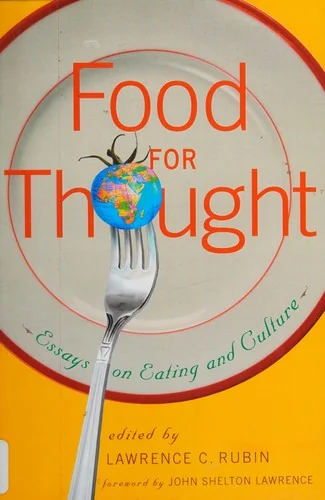
Food for Thought: Essays on Eating and Culture
✍️ Rubin, Lawrence CA scholarly collection of nineteen essays on the social and cultural aspects of eating.
The book functions as an interdisciplinary examination of how food shapes and is shaped by society. Rubin draws from various academic fields to critique modern dietary norms and industrial practices. The work highlights the tension between grassroots organic movements and mass marketing strategies. It also dissects the entertainment value of competitive eating and the strategic messaging in restaurant advertising. By focusing on these specific cultural artifacts, the text reveals how global agricultural policies impact local dining habits. The essays provide a critical look at the power dynamics inherent in food production and consumption.
Published in 2008 by McFarland & Company, this paperback volume reflects early twenty-first-century academic interest in food studies. It addresses contemporary debates on organic marketing and media influence that were gaining traction during that period.


📝 Description: Food for Thought: Essays on Eating and Culture
💎 Expert review
📖 Why choose it
Why this book is worth reading
This collection benefits students, researchers, and food enthusiasts interested in the intersection of society, public policy, and agriculture. Readers gain a critical perspective on how global economic forces, media representation, and industrial practices shape modern dietary habits. By dissecting phenomena ranging from competitive eating to commercialized organic farming, Lawrence C. Rubin provides valuable academic insight into the power dynamics underlying food production and consumption. Those looking to understand the broader cultural frameworks governing how and why we eat will find these nineteen interdisciplinary essays deeply illuminating and intellectually stimulating.
⭐ Reader reviews
Reader rating
Lawrence C. Rubin’s collection offers a rigorous, academic exploration of modern food systems, moving far beyond the scope of traditional culinary writing. The essays tackle complex topics like agricultural globalization, media influence, and fast food advertising with intellectual depth. However, potential buyers must note that this is strictly a work of food writing and cultural critique rather than a practical guide. It contains no recipes or cooking advice, making it entirely unsuitable for home cooks seeking kitchen inspiration. Instead, it serves a niche academic and sociological readership eager to decode the cultural artifacts of contemporary dining.